Anaheim, California · 1857 to now
The History of Anaheim
Anaheim began in 1857 as a corporation: fifty German shareholders in San Francisco bought 1,165 acres of a Mexican land grant, hired a surveyor to plant a vineyard, and drew lots for farms they had never seen. Wine built the town, a vine disease destroyed it, oranges rebuilt it, and in 1955 Walt Disney bought the groves. What follows is the whole arc — the eras, the places that vanished, the buildings that survived, and the film that proves it.
Anaheim quick facts
- Founded
- 1857
- Fifty German families from San Francisco bought 1,165 acres and planted a vineyard colony.
- Incorporated
- March 18, 1876
- Chartered by act of the State Legislature — unusual in Orange County, where most cities incorporated by election.
- What the name means
- Ana + Heim
- 'Ana' for the Santa Ana River that watered the colony, '-heim' for the German word for home.
- The land it sat on
- Rancho San Juan Cajón de Santa Ana
- The colony's acreage was bought from Juan Pacífico Ontiveros, holder of the Mexican-era land grant.
- County line
- 1889
- Anaheim spent its first 32 years in Los Angeles County; Orange County split off in 1889.
- Population today
- 346,824
- 2020 census — the most populous city in Orange County and tenth largest in California.
Timeline
9 eras that made Anaheim
Chronological, from Tongva country to the Platinum Triangle rebuild. Each era is the moment something structural changed — the land, the crop, the county line, the economy.
- Before 1769Era 1 of 9
Tongva ground along the Santa Ana River
Long before any survey stake went in, the flat land between the Santa Ana River and the Coyote Hills was Tongva territory — the people Spanish missionaries later called Gabrieliño, whose villages and trade routes reached from the coast into the inland valleys. Their Acjachemen (Juaneño) neighbors held the country south toward San Juan Capistrano, and the boundary between the two was a lived, negotiated thing rather than a line. The river was the reason people stayed: seasonal flows, willow thickets, game and a floodplain of deep silty soil. That same silt is why German winegrowers picked the spot in 1857, and why orange growers stayed for the next hundred years. Anaheim's whole economy is a footnote to a river the city later spent decades trying to control.
- Tongva / Gabrieliño homeland
- Acjachemen country to the south
- Santa Ana River floodplain soil
- 1769–1856Era 2 of 9
Mission cattle, then the rancho grants
Spanish colonization pulled the region into the Mission San Gabriel and San Juan Capistrano orbit, and the land became grazing country rather than settlement. After Mexican independence the missions were secularized and the plain was carved into private ranchos; the future Anaheim fell inside Rancho San Juan Cajón de Santa Ana, granted to Juan Pacífico Ontiveros. Cattle hides and tallow, not crops, were the export. When California became a U.S. state in 1850 the ranchos entered a long legal grind over title, and drought and debt pushed many grantees to sell in pieces. Ontiveros selling 1,165 acres to a group of San Francisco Germans in 1857 was one of those pieces.
- Rancho era land grant
- Ontiveros family holding
- Cattle-and-tallow economy
- 1857–1875Era 3 of 9
The Mother Colony: a wine company that became a town
Anaheim was not a frontier settlement that grew — it was a corporation that platted a town before anyone moved in. Fifty mostly German shareholders in San Francisco formed the Los Angeles Vineyard Society, hired surveyor George Hansen to find land and build the colony, and only later drew lots for the vineyard parcels. Hansen laid out a grid, dug an irrigation ditch from the Santa Ana River, planted the vines, and ringed the whole property with a living willow fence to keep out roaming cattle. Settlers arrived in 1859 to find their farms already three years into production. By the 1860s Anaheim wine was shipping out through Anaheim Landing, a port the colonists built on the coast at what is now Seal Beach.
- Los Angeles Vineyard Society
- Surveyor George Hansen
- Willow fence around the colony
- Anaheim Landing port, 1864
- 1876–1888Era 4 of 9
Incorporation — and the blight that killed the vineyards
Anaheim incorporated on March 18, 1876, by act of the State Legislature, giving the colony a city government and a downtown that already had hotels, a brewery and a Polish artistic colony that briefly drew actress Helena Modjeska and writer Henryk Sienkiewicz to the area. Then the vines began to die. Starting in the mid-1880s a disease locals simply called 'the Anaheim disease' — later identified as Pierce's disease, spread by insects — wiped out the vineyards within a few years. An economy built on a single crop collapsed almost completely. Growers replanted with Valencia oranges, walnuts and lemons, and the citrus decades that followed defined the city far longer than wine ever did.
- Incorporated March 18, 1876
- Pierce's disease wipes out vines
- Valencia oranges replace wine
- Modjeska's Polish colony
- 1889–1940Era 5 of 9
Citrus capital, packing houses, and the county line
In 1889 Orange County separated from Los Angeles County, and Anaheim became a market town in a county named for the fruit it shipped. Rail spurs ran into packing houses, the Pacific Electric Red Cars reached Anaheim in 1906, and the Sunkist cooperative turned local groves into a nationally advertised brand. It was also the city's ugliest chapter: in 1924 Ku Klux Klan-backed candidates won control of the Anaheim city council, and residents threw them out in a recall election the following year. Rudolph Boysen, hired as parks superintendent in 1921, crossbred the berry that carries his name on land in Anaheim before Walter Knott made it famous in Buena Park. The 1938 Santa Ana River flood tore through the lowlands and killed dozens across the county, forcing the flood-control channels that still box in the river today.
- Orange County formed, 1889
- Pacific Electric arrives, 1906
- Klan council recalled, 1925
- 1938 Santa Ana River flood
- 1953–1966Era 6 of 9
Disneyland buys the groves
Walt Disney's team went looking for cheap flat land near a planned freeway and found it in Anaheim's orange groves; roughly 160 acres were assembled in 1953–54 and the park opened July 17, 1955 to a live national broadcast and a famously chaotic first day. The park itself was only half the story — Harbor Boulevard filled with motels within a year, and the city's population multiplied several times over in a single decade. Anaheim's council leaned in, zoning a commercial-recreation district around the park and opening the Anaheim Convention Center in 1967, then the largest exhibition hall on the West Coast. Anaheim Stadium followed in 1966, luring the Angels down from Los Angeles. In thirteen years an agricultural town rewrote itself as a destination economy.
- Disneyland opens July 17, 1955
- Convention Center, 1967
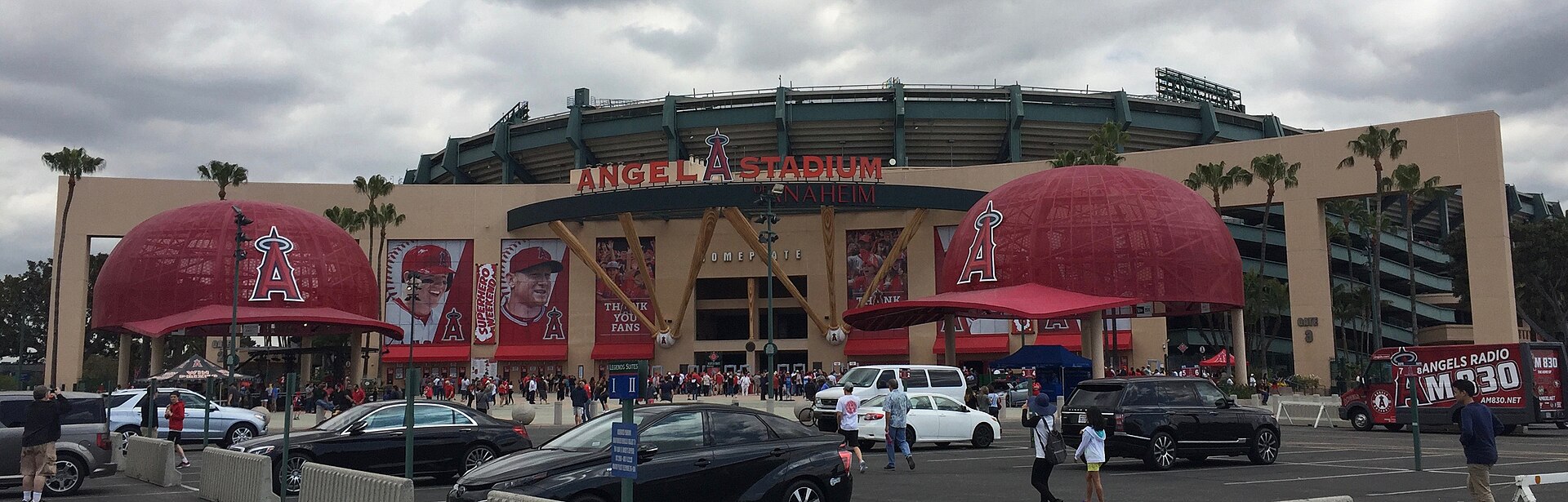
- Anaheim Stadium, 1966
- Angels move from L.A.
- 1957–1985Era 7 of 9
Freeways, tract houses and the parts of town that got cut
The Santa Ana Freeway (I-5) and later the 57 and 91 made Anaheim reachable from everywhere, and the groves went under tract housing at a speed that surprised even the developers. Convenience came with cuts: freeway alignment and redevelopment took whole blocks of the old downtown, and by the 1970s much of the 19th-century commercial core had been cleared for projects that arrived slowly or not at all. Residents pushed back — the preservation movement that produced the Anaheim Colony Historic District grew directly out of watching original Victorian and Craftsman housing disappear. Melodyland, the theater-in-the-round that opened across from Disneyland in 1963, tracked the same era: rock shows, then a megachurch, then a parking lot. The city that emerged had a world-famous resort district and a downtown that had to be rebuilt almost from scratch.
- I-5 widening reshapes downtown
- Anaheim Colony Historic District
- Melodyland, 1963–2003
- Redevelopment-era clearances
- 1993–2012Era 8 of 9
The resort district, a hockey team, and a city arguing with itself
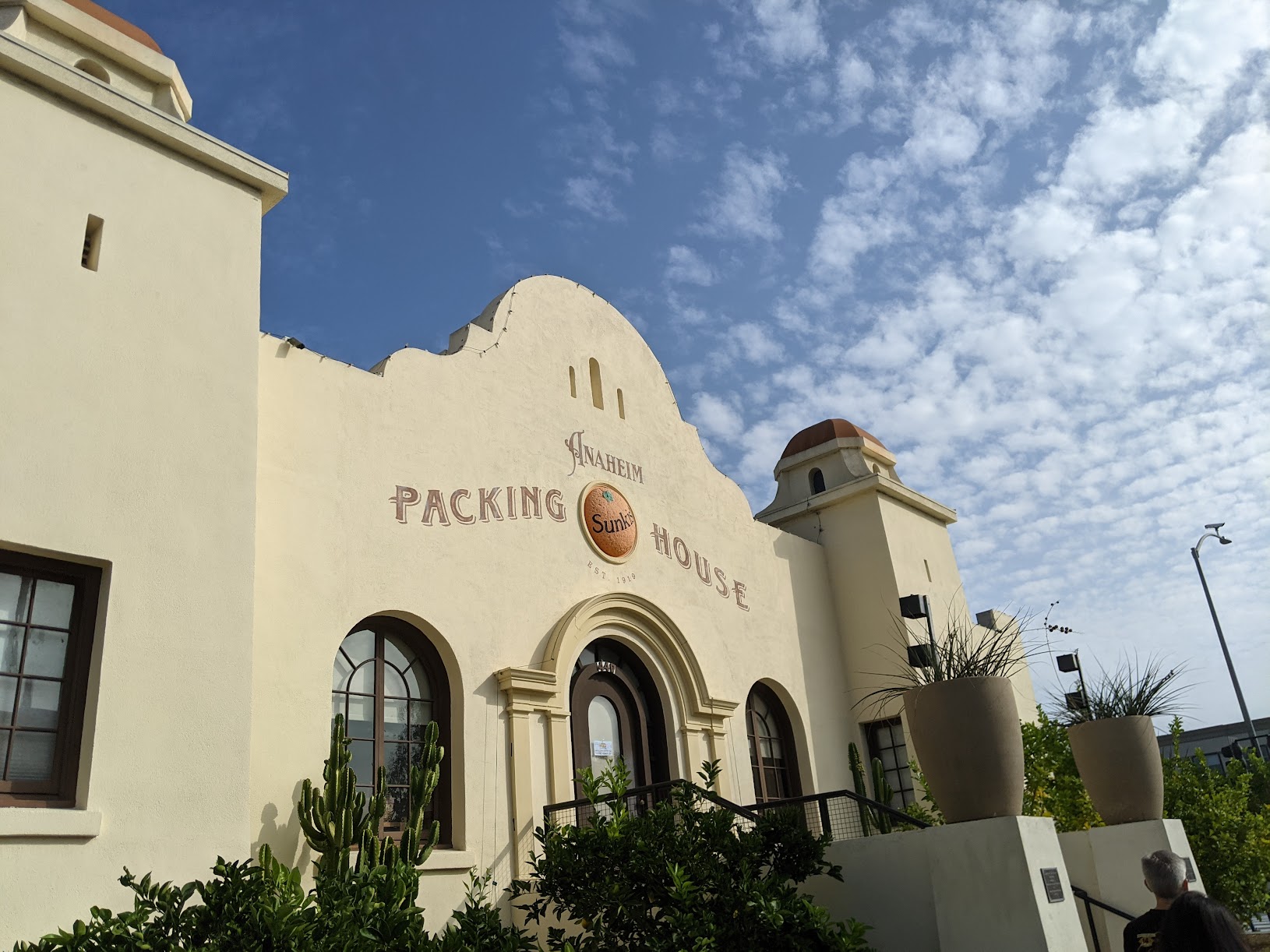
The Mighty Ducks arrived in 1993 with an arena on Katella, and the late-1990s Anaheim Resort plan rebuilt Harbor Boulevard with landscaping, hotels and a second Disney gate, Disney California Adventure, in 2001. Downtown got its own second act: the 1919 Sunkist packing house was restored and reopened in 2014 as a food hall, anchoring a Packing District built around buildings the city had nearly lost. Not everyone shared the boom. In July 2012 police shootings in Anaheim's flatland neighborhoods triggered days of protest and a national argument about who the city's prosperity was actually for; the fallout pushed Anaheim to switch from at-large to district-based council elections, giving neighborhoods outside the resort their own representatives.
- Ducks arena opens, 1993
- Disney California Adventure, 2001
- 2012 protests
- District elections adopted
- 2014–todayEra 9 of 9
Little Arabia, ARTIC, and the next downtown
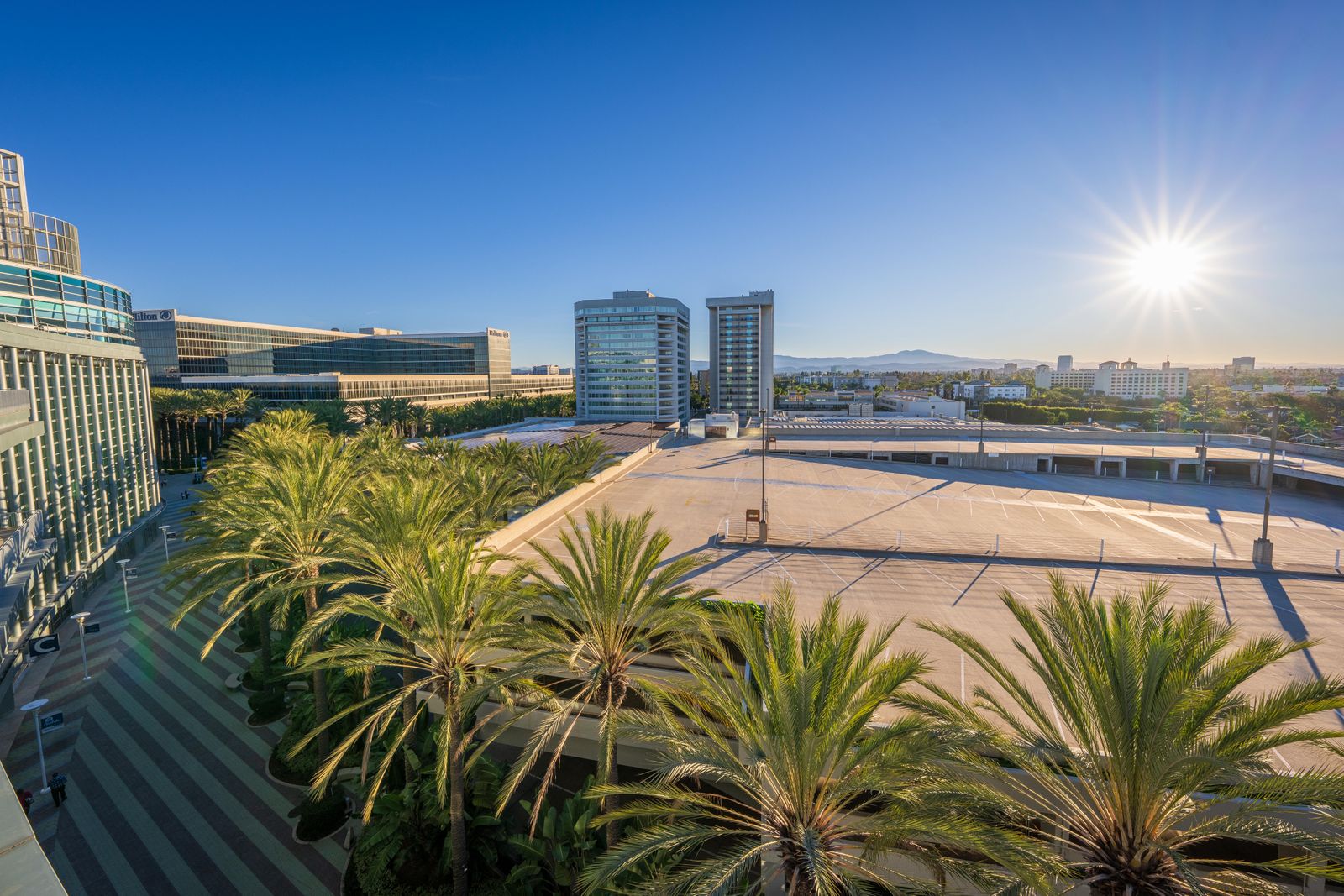
The transit hub ARTIC opened in 2014 next to Angel Stadium, a deliberately conspicuous statement that Anaheim intended to be a destination you arrive at, not drive through. In 2022 the city council formally designated Little Arabia along Brookhurst Street — the first official Arab-American district in the United States, recognizing a business corridor that had grown quietly since the 1980s. The Packing District, Center Street Promenade and Pearson Park pulled residents back into a downtown that spent forty years hollowed out. Now the Platinum Triangle around Angel Stadium is being rebuilt again as a mixed-use district, the largest ground-up change to Anaheim's map since Disneyland bought the groves. The through-line hasn't changed since 1857: outsiders buy the flat land, and the city rearranges itself around them.
- ARTIC opens, 2014
- Packing House food hall, 2014
- Little Arabia designated, 2022
- Platinum Triangle rebuild
Gone
Lost landmarks
Places that really existed in Anaheim and no longer do — plus whether anything of them is still findable on the ground.
The Anaheim vineyards and the willow fence
1857–1888
The colony's defining feature was agricultural infrastructure: hundreds of acres of vines, an irrigation ditch off the Santa Ana River, and a living willow fence planted around the whole property because barbed wire didn't exist yet and cattle did. Anaheim briefly ranked among California's largest wine producers. Pierce's disease killed the vines within a few seasons in the mid-1880s and growers pulled them out entirely. Nothing of the fence survives, but the colony's original grid — the wide, oddly generous downtown blocks — is exactly the layout George Hansen staked out.
Anaheim Landing
1864–1870s
The colonists needed a way to move wine out and lumber in, so they built their own port about twelve miles away where Anaheim Creek met the ocean. It had a wharf, a warehouse, and an entrance channel treacherous enough to wreck ships more than once. For a few years its shipping volume approached San Pedro's; the railroad's arrival in Anaheim in 1875 ended it almost overnight. The site is inside the Naval Weapons Station at Seal Beach today, and the name survives on the water: Anaheim Bay.
The Pacific Electric Red Car line
1906–1950
Interurban Red Cars connected Anaheim to Los Angeles decades before the freeway, hauling passengers, mail and citrus on an electric line that made a farm town commutable. Service ended around mid-century as buses and cars took over and the company dismantled the network. The rolling stock is gone, but the right-of-way is still legible in the aerial view — unusually straight diagonal easements, alley-width parcels and utility corridors that cut against Anaheim's otherwise strict grid.
Melodyland Theatre
1963–2003
A 3,000-seat theater-in-the-round built directly across from Disneyland, Melodyland booked Broadway tours and major rock and soul acts through the 1960s. It failed commercially and was bought in 1969 by a Pentecostal congregation that turned it into Melodyland Christian Center, one of the best-known charismatic churches in the country. The property was sold and the round building demolished in 2003. The site near Disney Way is parking and resort development now — no trace of the drum-shaped shell remains.
Rudolph Boysen's berry patch
1920s
Boysen, Anaheim's parks superintendent from 1921 to 1950, brought experimental berry vines with him and planted them on family farmland in Anaheim, where his blackberry–raspberry–loganberry cross finally fruited in 1923. He couldn't make it pay, hurt his back, and abandoned the crop. Walter Knott tracked down the surviving vines, propagated them in Buena Park and named the fruit after him. The original Anaheim patch is long gone; the city named Boysen Park — the one with the Navy jet in the playground — after him instead.
Disneyland's Skyway
1956–1994
For 38 years, gondolas crossed the park between Fantasyland and Tomorrowland, passing straight through a hole cut in the Matterhorn. It was one of Disneyland's earliest attempts at a transportation ride that doubled as a view, and generations of Anaheim kids measured a park visit by whether they got a bucket. It closed in November 1994 over capacity and maintenance realities. The Fantasyland chalet station survives as a shop façade, and the Matterhorn still carries the sealed tunnel the cabins used to pass through.
The downtown Anaheim of the packing era
1880s–1970s
Center Street and Los Angeles Street (now Anaheim Boulevard) carried a full 19th-century business district: brick storefronts, hotels, a bank block, and the packing houses and rail spurs behind them. Redevelopment and freeway work in the 1960s and 1970s cleared most of it, and several planned replacements never materialized, leaving surface lots for years. What's left is fragmentary but findable — the Carnegie Library, the 1919 Packing House, the 1925 Packard showroom, and the Colony's surviving houses a few blocks north.
Still here
Still standing
Anaheim lost most of its 19th-century fabric, but not all of it. These are historic places you can put on a walking route today — several of them within a mile of each other downtown.
Mother Colony House
Built 1857
The oldest house in Orange County, built for surveyor George Hansen out of redwood shipped down the coast in the colony's first year. It sits at Founders' Park on North West Street, moved once but intact, furnished as a small museum. Open to the public on scheduled days and free.
Woelke–Stoffel House
Built 1894
A Queen Anne Victorian with a corner turret, relocated to Founders' Park next to the Mother Colony House and restored as part of the same city-run historic site. It reads as the moment Anaheim stopped being a farm colony and started building for show. Grounds are publicly accessible; interior tours run on posted days.
Anaheim Carnegie Library
Built 1908
A Classical Revival library designed by John C. Austin, opened in 1909 and the last surviving Carnegie library in Orange County. It served as a library until 1963, spent the 1970s as a city personnel office, and is now part of the Muzeo museum campus on Anaheim Boulevard. Listed on the National Register in 1979 and open as an exhibition space.
Anaheim Packing House
Built 1919
A Sunkist citrus packing house built beside the rail spur, restored and reopened in 2014 as a two-level food hall with a courtyard and live music. The steel trusses, loading doors and clerestory windows are original, which is the point — you're eating inside the machine that shipped Anaheim's oranges. Free and open daily.
Packard Building
Built 1925
A former Packard automobile showroom in the Packing District, its tall arched display windows still reading as a car dealership from the street. It was restored alongside the Packing House and now houses restaurant and event space. Publicly accessible during business hours.
Anaheim White House
Built 1909
A colonial-revival mansion built by Dosithe Gervais, later home to the Truxaw family for fifty years, and a restaurant since the 1980s. Fire gutted it in February 2017; it was rebuilt to match the original and reopened in 2018. Open to the public as a restaurant on South Anaheim Boulevard.
Pearson Park Amphitheatre
Built 1927
An open-air amphitheatre in the city's oldest park, still hosting summer concerts and community theatre nearly a century later. The park's mature trees and lawn are the closest thing Anaheim has to a 1920s streetscape. Free to enter; ticketed for shows.
Anaheim Colony Historic District
Built 1870s–1930s
Not one building but roughly a square mile of the original 1857 colony grid north and east of downtown, protected as a historic district after decades of teardowns. Victorian, Craftsman and Spanish Revival houses sit on the wide lots Hansen platted for vineyards. It's a public neighborhood — walk or drive it any time.
Disneyland Opera House
Built 1955
The oldest building in Disneyland, standing on Town Square since opening day in 1955 and originally used as the park's lumber mill before becoming a theater. It has housed the Lincoln and Walt Disney presentations for most of its life. Inside the park, so admission applies.
Angel Stadium and the Big A
Built 1966
Anaheim Stadium opened in 1966 for the Angels, was enclosed for the Rams in 1980, then re-opened to the outfield mountains in a 1990s renovation. The 230-foot Big A sign — originally the scoreboard support behind left field — was moved to the parking lot in 1980 and is still the most recognizable object on the 57 freeway. Open on game days and for tours.
Watch
Two documentaries about Anaheim
Long-form film on the city — one on modern Anaheim's divide, one on the county history Anaheim sits at the center of.
History love
Anaheim California History | From Vineyards to Disneyland and Beyond
A full-length history of Anaheim tracing the city from its 1857 vineyard colony origins through the citrus era and Walt Disney's arrival. It covers the founding families, the wine and orange economies that built the town, and how a farming community became a world-famous destination.
Orange County Historical Society
"A Century of History" — Phil Brigandi
The late Phil Brigandi, Orange County's most meticulous local historian, walks through a century of county history from the rancho grants to the postwar boom. Anaheim recurs throughout as the county's first real town and its most-changed one.
Archival
What Anaheim looked like a long time ago
Live television from the day the orange groves stopped being orange groves.
Marcio Disney
1955 Disneyland Opening Day — complete ABC broadcast
The full live telecast from July 17, 1955, cameras and all, broadcast from what had been an Anaheim orange grove eighteen months earlier. Beyond the park itself, it's the best surviving moving picture of the flat agricultural Anaheim that Disneyland replaced.
Short clips
Four pieces of Anaheim history
A landmark, a lost piece of infrastructure, a famous resident and the turning point that created Orange County.
Daps Magic
Angel Stadium — Disney This Day, August 31, 1964
A one-minute account of the groundbreaking that put a major-league ballpark in Anaheim's farm belt. Subject: the landmark that made the city a sports town.
Anaheim History Guy
Old Anaheim Stadium train station vs. the new ARTIC station
A local walk-through comparing the modest platform that served Anaheim Stadium for decades with the 2014 ARTIC terminal that replaced it. Subject: a lost piece of everyday Anaheim infrastructure.
Halos In The Infield
Gene Autry — the Angels' first owner
A retrospective on the singing cowboy who bought a baseball team and moved it to Anaheim. Subject: the famous resident whose name is on the street outside the stadium.
L.A. in a Minute
Orange County was originally part of L.A.?!?
A short explainer on the 1889 split that pulled Anaheim and its neighbors out of Los Angeles County. Subject: the turning point that gave Anaheim a county of its own.
Who
Notable people from Anaheim
Six people whose connection to the city is real and specific — not a list of celebrities who once played the Honda Center.
George Hansen
Surveyor and colony superintendent
The German-born surveyor who chose the site, platted the grid, dug the irrigation ditch and planted the first vines before any settler arrived. Anaheim's street layout is essentially his drawing. The Mother Colony House was built for him in 1857.
Helena Modjeska
Actress, arrived 1876
The celebrated Polish stage actress came to the Anaheim area in 1876 with a small utopian colony that included novelist Henryk Sienkiewicz. Farming failed quickly; Modjeska returned to the stage and became a star of the American theatre. Her later canyon home southeast of the city is a county historic site.
Rudolph Boysen
Parks superintendent, 1921–1950
Anaheim's parks director for nearly thirty years and the horticulturist whose berry cross fruited here in 1923. He never commercialized it — Walter Knott did — but the boysenberry is named for him. Boysen Park on East La Palma carries his name.
Gene Autry
Founding owner, California Angels
The singing cowboy bought the expansion Angels in 1961 and moved them to Anaheim Stadium in 1966, tying the city's identity to a major-league team for the next six decades. He owned the club until his death in 1998; the street outside the stadium is Gene Autry Way.
Carl Karcher
Founder, Carl's Jr.
Karcher started with a hot dog cart and opened his first full Anaheim restaurant in the 1940s, growing Carl's Jr. into a national chain from an Anaheim base. He remained one of the city's most visible civic figures and philanthropists for decades.
Gwen Stefani
Musician, No Doubt
No Doubt formed in Anaheim in 1986 and played the Orange County club circuit for years before Tragic Kingdom made them global in 1995 — an album titled, pointedly, after the theme park down the road. Stefani grew up in the area and has kept the Anaheim reference in her work ever since.
Go see it
Walk it yourself
Most of what's left is walkable in an afternoon: Founders' Park, the Carnegie Library, the Packing District, then the Colony grid on the way back.
A note on sources: local histories disagree, especially on early colony dates, exact acreage and who deserves credit for what. Where accounts conflict we've used the widely accepted version and said so carefully. For primary material, the Anaheim Public Library's Anaheim Heritage Center, the Anaheim Historical Society, the Orange County Historical Society and the Orange County Archives all hold documents, photographs and oral histories that go far deeper than any web page. Corrections are welcome — see our disclaimer and sources page or contact us.